The industrial spark of the East End, of course, plays a large part in this story. Bryant & May, the first British match factory, flickered into life beside the river in 1861; followed a year later by the invention of the world’s first plastic (Parkesine) – created in a Hackney Wick workshop in 1862. But it is the social, cultural and political experimentation and creativity which always sticks out from the archives to me.
The Match Girls Strike of 1888, which erupted at the Bryant & May factory near the Lea, was itself a remarkable act of social and political experimentation. At a time when working class women were expected to be silent, compliant and invisible, the striking matchmakers reshaped the very idea of collective action. Their walkout tested radical new alliances – between young women workers, journalists, suffragists, and social reformers – creating an experimental model of grassroots organising that would influence later labour movements.
In refusing both the toxic conditions of their workplace and the social constraints placed upon them, the Match Girls turned the Lea-side factory district into a laboratory of political possibility, proving that even those written out of power could rewrite the terms of struggle.
In the post-war decades, this spirit of experimentation resurfaced powerfully in Joan Littlewood and Cedric Price’s Fun Palace – envisioned for a site on the Lea at Stratford Marsh. Drawing on the labour movement’s insistence that culture and education should be accessible to all, the Fun Palace extended these ideals into the realm of creativity itself.
This involved working with a vast team of theorists, artists and politicians, including architectural historian Reyner Banham, Labour MP Tony Benn, and engineer Buckminster Fuller. It proposed a radically democratic space where leisure, learning, engineering, art, and play could merge without hierarchy – an architecture of participation rather than consumption.
In many ways, it was a natural evolution of the post-war socially progressive ideals embodied by Littlewood, specifically: a belief that ordinary people deserved not only fair working conditions – but also the freedom to imagine, invent and collaborate in shaping their own futures.
Of course, the Fun Palace was never constructed. The Newham planning authority suggested that the site was needed for the construction of a storm water retention system. It’s ideals, however, circulated the landscape and wide beyond.
The project served as a model for the high-tech formalism for the 1976 Centre Pompidou in Paris and subsequent postmodern architectures; as well as cultural relevance, featuring in the BFI’s ‘Britain on Film’ project, which offered glimpses of London’s urban life in 1963.
The Olympic Games also recognised the project as an antecedent of the Olympic Park in its own playful interventions – or what had been called an Olympicopolis. Caroline Bird’s poem-installation, ‘The Fun Palace‘ (2011), which was displayed as part of the Olympic cultural programme, reflected the ongoing influence that Price and Littlewood’s design had on the imagination of the River Lea as a creative, generative riverine landscape.
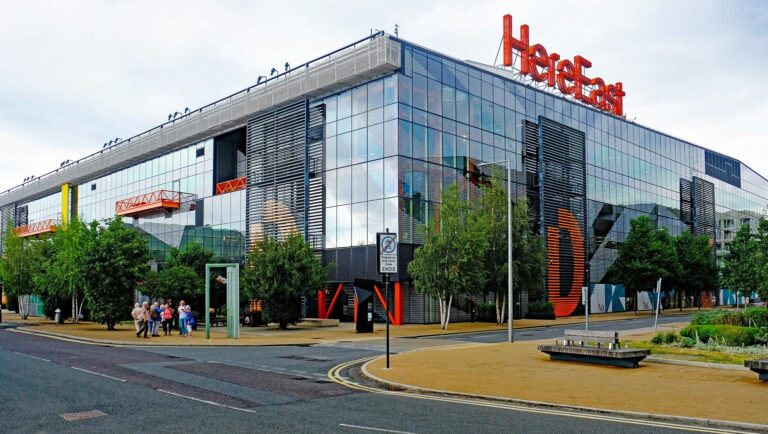
The emergent, playful form of the Fun Palace has also served as an influence for Hawkins\Brown Architects retrofitting of the old Olympic Broadcast Centre into Here East, which looked to capture a ‘a 21st century cabinet of curiosities’
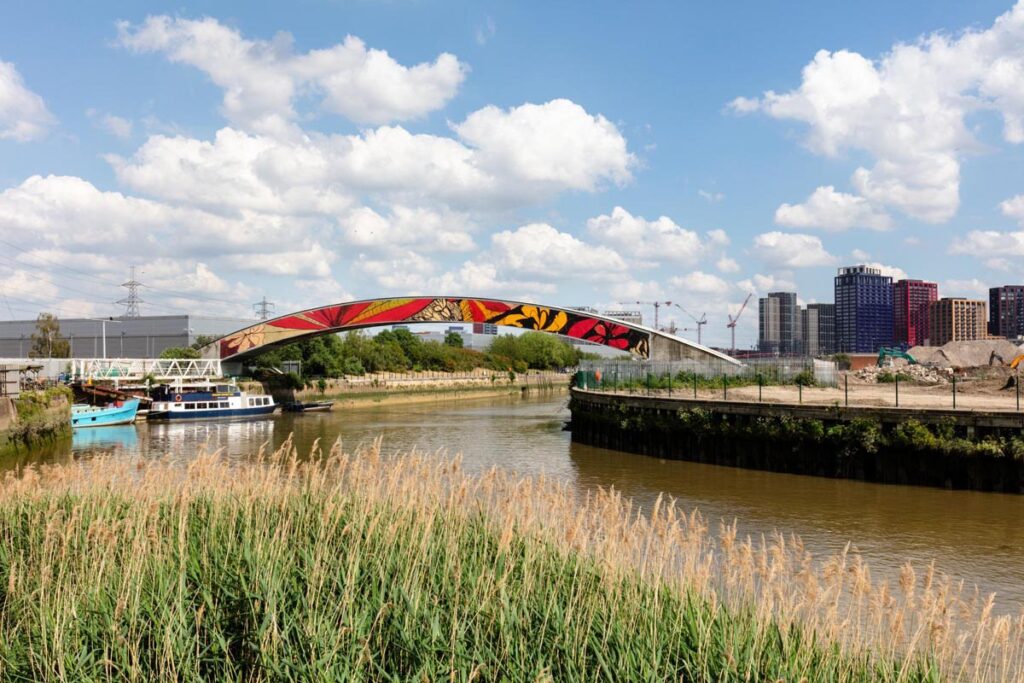
If the Fun Palace existed largely as a blueprint of what could have been, The Line offers a tangible continuation of its ethos along the contemporary River Lea. Established in 2015, London’s first dedicated public art walk threads sculptures, installations, and site-responsive works along the river’s towpaths and tidal marshes, making creativity not a destination but a route – something encountered in motion, by accident, in the folds of everyday life.
There are countless fascinating interventions into urban space to explore along The Line. I am often struck by Abigail Fallis’ piece, DNA DL90 (2003), which consists of 22 shopping trolleys in the shape of a double helix rising from the banks of the river.
Peering through the helical structure you can observe Canary Wharf rising in the background – a stark reminder of how The Line expands the Fun Palace’s promise of culture without walls – embedding artistic experimentation directly into the landscape while refusing the idea that art belongs only in sanctioned institutions or central districts.
Instead, it lets the river itself become the gallery, the curator, the connective tissue. In doing so, it rescues the River Lea from the margins, repositioning it as a place where public imagination is not only invited but actively cultivated. Like Littlewood and Price’s vision, The Line treats creativity as a civic right: something to be wandered into, lived with, and continually remade.